The one page · one unit → one site → one customer → the money
One pod, one client, one site. That is the whole road.
Quotes, then sites, then the pitch, then meetings, then the letter of intent, then funders. Everything in the five lists feeds one of these six stages.
Stage now
Quotes in
Plus site
Site and saving
Plus LOI
Customer signs
Fundable
Walk to funders
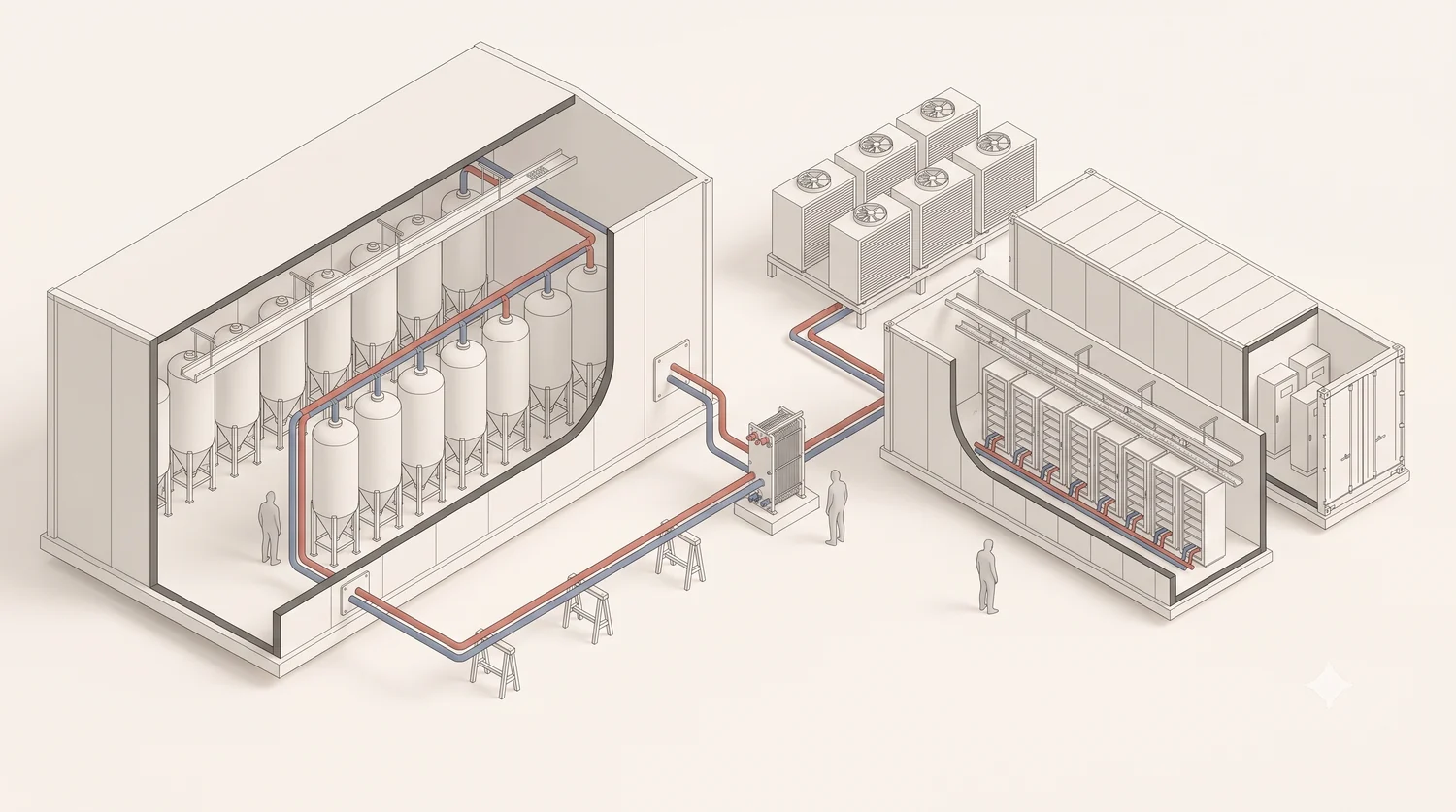
One pod beside a host plant · the loop crosses at the plate exchanger, racks to the right, dry coolers above, power module at the end. Click to enlarge.
The Six Stages
Tick a stage when its proof exists. Click a stage to comment on it in the column beside.
1
Get three quotes · one final figure for the first podweeks 1 to 3
Three quotes on every cost line: pod, transformer, permitting, engineering, peer review, install, commissioning. This tells us how much funding to ask for.
LeadAssistCheck
Broker and permitting fees plus studies×3 quotes
Client and ML brokerage fee (we will need a broker here)×3 quotes
Transformer and grid connection×3 quotes
Full engineering (CSA plus MEPF)×3 quotes
Peer review engineering plus commissioning agents×3 quotes
Legal (site, client, host, ML) plus insurance and codes×3 quotes
In company project overheads×3 quotes
Contingency and working capital×3 quotes
proofA cost we will stand behind
2
Sites · cost per kWh and ready for service dateweeks 1 to 4
The critical information that has to be on the client pitch. Get a series of brokers that just look for sites for us, then map the sites and where we are with each.
LeadAssistCheck
Identify lower cost per kWh states
Identify the WWTPs
Connect with each WWTP
If viable, add to the list and trigger next steps
If you are assigned to a site you own the site, the process and the triggers
proofA ranked site shortlist
3
Client first pitch deckweeks 2 to 4
Who we target, where they would deploy, their pain points. One standard deck, whole team practised on it, each member given names to reach.
LeadAssistCheck
Client list, location, expansion plans, problems
Client LOI draft, against what the funders want to see
Client focused pitch deck
Review, test and refine the deck
proofOne deck, team rehearsed
4
Client meetingsweeks 3 to 6
Everyone books meetings. First meeting finds the pain points and logs them. Second meeting is a proposal answering those points by name.
LeadAssistCheck
Whole team able to present the pitch deck
Set up client meetings (whole team)
Understand and document client pain points
Find a site and adapt the solution to suit client needs
Second client meeting
Client negotiations
Sign client LOI
proofPain point log plus second meetings
5
Host site LOIweeks 5 to 8
Stage five was missing from the previous version. Named here so the run reads one to six.
LeadAssistCheck
Written confirmation of spare electricity on the chosen site
Non binding host agreement signed
Interface and boundary document agreed
proofA signed host letter
6
Costed pod plus host LOI plus client LOI · walk to fundersweeks 7 to 10
LeadAssistCheck
List of potential funders and funding paths
How much funding is needed and the return
Other requirements
proofMoney in the bank for pod one
Client requirements
The chain that turns a client conversation into funding. Each answer sets the next step. Type into a box to fill it.
01
How much power
02
Where
03
When
04
Certifications
05
Equipment
06
Connectivity
07
Letter of intent
Comments on Client Requirements
No comments yet.
Pick your name on Loom to comment
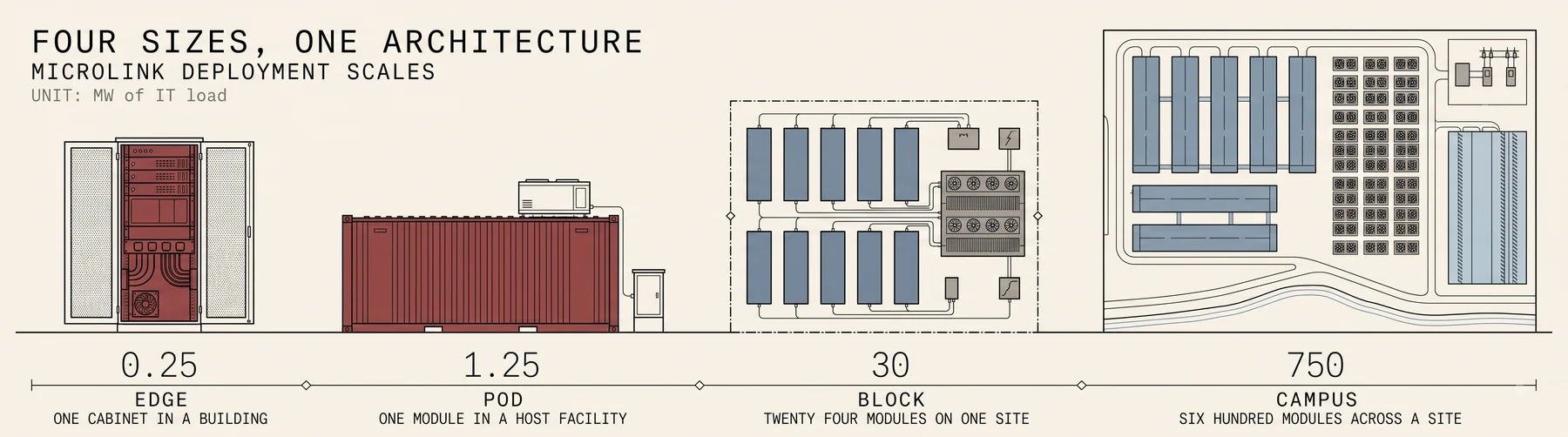
Four sizes, one architecture · 0.25 MW edge, 1.25 MW pod, 30 MW block, 750 MW campus. Unit: MW of IT load.
Host supplies grid: $7M to $12M · we pay grid works: $9M to $14M
List 1 · The Pod · Month 1 · weeks 1 to 4
The Best POD
Requirements · decide what we are building, and for whom
0 of 2
Requirements: the one-page 'what it must do' sheet
Critical for funding
LeadAssistCheck
Document we can send Manufacturers with the basic POD requirements for a high level cost.
Finished whenOne page an outside engineer could read and start drawing from without asking a question.
What it costs usFree. Our own time.
Requirements: the client requirements document
Critical for funding
LeadAssistCheck
Client power req KW?
List the certifications clients require before they will sign.
List the specific materials and equipment types clients will accept.
State the fibre and connectivity requirements.
Answers determine POD configuration determine Type of site confirms LOI leads to Funding
Finished whenA one-page client requirements sheet that the drawings are then built to satisfy.
What it costs usFree. Our own time.
Comments on this section
No comments yet.
Pick your name on Loom to comment
Design · turn the requirements into drawings
0 of 3
Design: the 'how we will build it' approach note
Critical for funding
LeadAssistCheck
Keep it to two or three pages, matching the one-page requirements sheet.
Finished whenA written approach note a builder could quote against.
What it costs usFree. Our own time.
Design: Documentation
Critical for funding
LeadAssistCheck
Elec/MEch SLDs. It must run from the host site's supply, through the switch panels, through the battery backup, out to the computer cabinets.
Plans sections elevations
Structural Calculations
CFD?
Check every drawing against every other drawing and resolve the clashes.
Get the set stamped by the engineers.
Bind it into one final pack holding all the engineering documentation · 'Basis of Design' simply means the document recording what the design is and why.
Date it and declare the design frozen. From here, changes are exceptions that need sign-of
Finished whenA signed electrical single line diagram.
What it costs usCosts money · outside engineer's fee. Workaround: appoint one engineer across all four drawings on a single fixed scope, and ask for payment deferred to funding or a success fee.
Design: the liquid-cooling numbers the contracts will rely on
Critical for funding
LeadAssistCheck
Fix the guaranteed supply and approach temperature at the cooling distribution unit secondary loop, referenced to the recognised thermal guideline water classes.
Write the coolant chemistry specification: acidity, conductivity, particulates, biocide regime, sampling frequency, and who pays to put it right when the fluid goes out of specification.
Fix the cooling distribution unit redundancy level, filtration, flow rate and pressure difference at the rack manifold.
Specify leak detection method and response time.
Decide the equipment boundary · whether the cooling distribution units and manifolds are ours or the customer's. Recent large deals make them customer-supplied, which moves who carries the liability.
Write down the dry cooler rejection path as a performance commitment, not just a design feature: what keeps the customer running when the host site's thermal path is unavailable.
Finished whenA one-page schedule of cooling numbers and boundaries the lawyer can drop straight into the customer agreement.
What it costs usFree. Our own time. Part of the engineering appointment already made.
Comments on this section
No comments yet.
Pick your name on Loom to comment
Procurement · quantities first, then prices
0 of 2
Procurement: the procurement strategy
Critical for funding
LeadAssistCheck
List every item the design requires and how many of each. A Bill of Quantities is a list of what and how many · it carries no prices at this stage.
Flag the items that will need the longest lead time so the build timetable can be planned around them.
Decide what software, if any, we use to run procurement, and how we track material ordered, paid for, confirmed and factory-tested.
Procurement strategy for the POD and The For the Srvices
Set out how payment milestones are tracked and how we make sure the final installation date is met.
Decide whether suppliers deliver to site, and which shipping terms suit this project.
Decide where equipment is stored, who is responsible for it not being stolen, and what insurance is needed.
Set payment terms and how cash flow is managed against them.
Include the supplier framework and the contract terms we will use.
Link the whole thing to the project planner so ordering dates drive the schedule.
This is a plan only. Nothing is ordered and no money is committed.
Finished whenA written framework covering all of the above, linked to the project plan.
What it costs usFree. Our own time. Assess software options now, buy nothing.
Procurement: the costed Bill of Quantities
Finished whenA fully costed Bill of Quantities with named suppliers, prices, delivery times and deposit terms.
What it costs usFree. Our own time. Supplier meetings and quotes cost nothing.
Comments on this section
No comments yet.
Pick your name on Loom to comment
Compliance and logistics
0 of 2
Compliance: the safety-approval and testing plan
Supporting
LeadAssistCheck
List the product-safety approvals the finished unit needs before anyone will let us switch it on.
Main approval certifies the whole container as a single approved product, which makes the local building inspector's job fast.
For each approval record who issues it, roughly what it costs, how long it takes, and when in the build we apply.
Set out the testing sequence that follows: test at the factory before shipping, re-test once installed, run at full power using dummy electrical loads, then deliberately cut power to prove it recovers.
This is standard for a data centre, so the engineering consultant appointed for the drawings should be asked to help write the testing half.
Finished whenA written plan naming each approval and each test, with the issuer, cost and lead time.
What it costs usFree. Our own time. Writing the plan is free. The approvals and tests cost money later, after funding.
Logistics: the transport and installation plan
Supporting
LeadAssistCheck
Record the unit's dimensions and weight, and confirm whether that counts as an oversized load.
List the road permits needed and roughly what they cost.
Name the specialist heavy-haulage firms that carry this kind of load.
Set out the crane and groundwork needed at the far end to set it down and bolt it in.
Finished whenA written plan with named haulage firms, an estimated cost per mile, and the permit list.
What it costs usFree. Our own time.
Comments on this section
No comments yet.
Pick your name on Loom to comment
List 2 · Sites · Month 2 · weeks 5 to 8
We need ONE host site and a signed non-binding agreement to host the unit.
Why this block. The unit is now defined, so we know the space, weight and electricity to look for. Electricity is what stops most projects: plugging into a site that already has spare power avoids a wait for a new grid connection that runs for years.
Write it down once, properly
0 of 2
Sites: the one-page site requirement sheet
Critical for funding
LeadAssistCheck
State the electricity requirement plainly: the unit carries 1.25 megawatts of computing, but a site must supply more, because cooling pumps and fans also draw power and electrical equipment is rated with a safety margin.
Give the working number: about 1.5 megavolt-amperes of spare capacity, and ask for 1.75 to 2.0 to leave headroom. Megavolt-amperes is the measure electricity companies use for the total size of a supply, always a little larger than the useful power.
State the floor area needed.
State the floor strength, taken straight from the structural calculations.
State the road access needed for a container lorry and a crane.
State the internet connection needed nearby.
Keep it to one page so anybody can screen a site against it in five minutes.
Finished whenA one-page sheet that lets anybody screen a site in five minutes.
What it costs usFree. Our own time.
Sites: the Site Strategy Document
Critical for funding
LeadAssistCheck
One document covering the whole site search, rather than several scattered notes.
List the types of site worth chasing: sewage treatment works, food and drink factories, cold stores, university and hospital heating plants, and best of all sites where a large power user has shut down · closed power stations, old aluminium smelters, abandoned crypto-mining sheds, which already have a big unused connection.
Set out how to find them and who to contact, including the electricity companies' business development teams, who are free to talk to and know exactly which sites have spare capacity.
Include the scoring method for ranking a site the same way every time, with spare electricity as the pass-or-fail test and everything else secondary.
Document the process for obtaining written confirmation of spare electricity, and what it involves.
Set out what kind of land agreement we must insist on, and why a casual permission to occupy is useless to a lender: it must be a registered lease that lasts longer than the loan, can be used as security, and survives the landlord's own bank taking over the site.
Set out the local rules and permitting requirements to check for each viable site.
Note where each step costs money and what the workaround is.
Carry the working lists inside it: the site matrix, the site list, the companies to set up meetings with, and the permitting requirements list.
Finished whenOne document any team member could pick up and run the entire site search from.
What it costs usFree. Our own time. Our time. This replaces six separate tasks.
Comments on this section
No comments yet.
Pick your name on Loom to comment
Go and get a site
0 of 2
Sites: contact development bodies and property agents
Supporting
LeadAssistCheck
Approach regional and state economic development organisations, which exist to place businesses in their area and keep lists of ready-to-use industrial sites.
Approach commercial property agents who specialise in industrial sites.
Work the contact lists held in the Site Strategy Document, and feed results back into it.
Finished whenEnquiries out to the development bodies and agents covering our target regions.
What it costs usFree. Our own time. These bodies are free to approach.
Sites: get written confirmation of spare electricity
Critical for funding
LeadAssistCheck
Obtain a letter from the electricity company or site owner confirming how much spare capacity exists and how soon it can be made available.
Follow the process documented in the Site Strategy Document.
A verbal 'yes, plenty' is worthless to a funder · it must be in writing.
This is one of the most valuable pieces of paper in the whole project.
SIGN LOI
Finished whenA written letter or email confirming the spare capacity and the timescale.
What it costs usMostly free. An initial capacity enquiry through the electricity company's business development team normally costs nothing. A formal load or connection study does cost and varies by utility. Workaround: stay with the free informal enquiry until one site is chosen, then pay for a single study on that site only.
Comments on this section
No comments yet.
Pick your name on Loom to comment
Paper the host relationship · the biggest gap we have
0 of 3
Sites: the host partner agreement package
Critical for funding
LeadAssistCheck
We sit inside somebody else's working industrial plant and neither side of that relationship is currently on paper. This is the single largest hole in the whole estate.
Get rights over the space: a licence to occupy or a sub-lease covering the module footprint plus plant room, riser, cable and pipe routes. A licence signs faster; a registered lease is what a financier can take security over.
Get access rights and wayleaves for pipework, the power feed, fibre entry, and entry outside the host's shift hours.
Produce an interface and boundary document: a single line diagram and a process diagram marking every ownership, maintenance and liability boundary.
Agree the process interruption indemnity and its cap. 'What happens if you shut down my plant' is the first question every host asks. Capped, insured, and consequential loss excluded both ways.
Assemble the host operating interface pack: permit to work, lock-out tag-out, confined space, hot work, emergency response and contractor induction.
Add non-disturbance and step-in protection so our modules and the customer service survive the host going insolvent, plus written confirmation the modules are our assets and not fixtures of their building.
Finished whenA signed package covering occupation, access, boundaries, the interruption cap and site safety.
What it costs usCosts money if outside counsel drafts it. Workaround: draft the interface and safety documents in-house and buy legal time only for the occupation and indemnity terms.
Sites: the power supply and sub metering arrangement
Finished whenA written supply and sub-metering arrangement agreed with the host.
What it costs usFree. Our own time. Agreement drafting is in-house; the utility enquiry is free.
Sites: the heat supply agreement
Finished whenA heat supply agreement with a price mechanism, a metering protocol and the carbon claim allocated.
What it costs usFree. Our own time. Only draft this if heat is actually part of the host deal.
Comments on this section
No comments yet.
Pick your name on Loom to comment
List 3 · Customers · Month 3 · weeks 9 to 12
We need ONE LOI.
Why this block. Now we have something real to sell · a finished design and a named place to put it. A funder is not buying our optimism, they are buying somebody else's promise to pay.
The Whole Team Sells.
0 of 1
Customers: the target customer list
Critical for funding
LeadAssistCheck
Target buyers for whom 1.25 megawatts is a complete answer, not a rounding error.
In rough priority: the host site's own computing needs; online marketplaces that resell computing capacity; drug-discovery and biotechnology research; smaller artificial-intelligence cloud companies; film and visual-effects studios; oil and gas survey processing.
Add a short paragraph recording who we are deliberately not selling to and why: the companies training the very largest artificial-intelligence models need hundreds of times our capacity; government research laboratories bring procurement and security clearance problems; bank transaction processing needs certified, permanently staffed buildings.
Get to 8 to 12 named organisations with a named contact where possible.
Finished whenA named list of 8 to 12 organisations, with the exclusions recorded.
What it costs usFree. Our own time.
Comments on this section
No comments yet.
Pick your name on Loom to comment
Build what we put in front of them
0 of 3
Customers: the one-page offer
Critical for funding
LeadAssistCheck
State what they get and how much computing capacity.
State what it costs and how long the agreement runs.
Give the two or three reasons to choose us: we can be running far faster than a conventional building, and our cooling is sized to carry the full load on its own.
Keep it to one page a customer can read in two minutes.
Finished whenA one-page offer.
What it costs usFree. Our own time.
Customers: the pitch pack · the pitch, then the questions
Critical for funding
LeadAssistCheck
First half, the pitch: the problem we solve, the unit and its specification, the commercial terms, our promise on how much of the time it will be running, and security.
Second half, the questions: our honest written answers to what every serious buyer asks.
Answer how much of the time it will run and exactly where that is measured.
Answer what we pay them if we miss it.
Answer how fast a fault is fixed when nobody is on site.
Answer how their equipment is physically secured and separated.
Answer whether they can see our independent security audits.
Answer 'you are brand new' directly: name the advisers and insurers, the firm contracted to attend site, the legal protections that make us safe to sign with, and a dated plan for when we will hold each audit.
Finished whenOne pack somebody outside the team could present, with every standard question answered honestly.
What it costs usFree. Our own time.
Customers: the letter template that actually counts
Critical for funding
LeadAssistCheck
Most letters of intent are worthless to a funder because they only say 'we are interested'.
Draft ours so the important part commits: a stated amount of capacity, a stated number of years, and a minimum payment owed whether or not the capacity is used.
Specify who signs it and record how financially solid they are.
Keep the conditions few and specific.
Separate the binding parts from the flexible parts clearly on the page.
Then upgrade it: a letter with no money attached is discounted by funders, so pair it with the reservation agreement that adds exclusivity and a deposit.
Finished whenA lawyer-checked template with the committing parts clearly separated.
What it costs usFree. Our own time. In-house legal time; outside review only if it can be deferred.
Comments on this section
No comments yet.
Pick your name on Loom to comment
The contract stack a customer actually signs
0 of 4
Customers: the contract stack · umbrella agreement, service order, service level schedule
Critical for funding
LeadAssistCheck
Right now we have a letter template and nothing behind it. A customer who says yes has nothing to sign.
Draft the umbrella agreement first: liability caps, indemnities, intellectual property, term, termination, assignment and confidentiality. Everything else hangs off it.
Draft the service order · the per-deal commercial sheet: committed power, number of modules, monthly and one-off charges, ramp schedule, term and the ready-for-service date.
Draft the service level commitment as a schedule to the umbrella agreement, never as a standalone document, so the umbrella's liability caps and remedies govern it.
Draft the service credit protocol: how credits are worked out, claimed and capped, and that credits are the only remedy.
Define ready-for-service and acceptance · the moment the customer accepts and billing starts, evidenced by the commissioning tests.
Finished whenA complete signable stack: umbrella agreement, service order, service level schedule and credit protocol.
What it costs usCosts money · this is the one place worth paying for proper drafting. Workaround: one lawyer, one fixed fee, reusable forms rather than a one-off per customer.
Customers: the liquid-cooling schedule to the service level agreement
Critical for funding
LeadAssistCheck
Take the cooling numbers produced in Month 1 and turn them into contract terms.
Cover guaranteed supply and approach temperature, coolant chemistry and who pays for remediation, cooling distribution unit redundancy and flow, and leak detection and response.
Allocate leak liability explicitly, including damage to the customer's own computer hardware · this is the clause that decides who pays when it goes wrong.
State whether the cooling distribution units and manifolds are ours or the customer's.
Write the dry cooler rejection path in as a contractual continuity guarantee.
Add the flush, fill and coolant handling procedure as a maintenance annex when there is time.
Finished whenA cooling schedule attached to the service level agreement, covering every term an air-cooled template misses.
What it costs usFree. Our own time. Drafting time, using the Month 1 numbers.
Customers: the site rules and access policy
Not Critical - change
LeadAssistCheck
No customer engineer gets onto a working industrial site without this, so it blocks the first site visit, not just the contract.
Cover badge issue, escorting, permit to work, lock-out tag-out, protective equipment induction, and delivery and rigging rules.
It has to be heavier than a normal data centre's version, because the customer is walking into somebody else's operating plant.
Line it up with the host's own operating interface pack so the two do not contradict each other.
Finished whenA written access policy a customer engineer can be inducted against.
What it costs usFree. Our own time.
Customers: turn the letter of intent into a reservation agreement
Not Critical for funding
LeadAssistCheck
The letters we are chasing carry no capital commitment, which is exactly why a funder discounts them.
Draft a reservation agreement that converts a non-binding letter into exclusivity plus a deposit.
State the capacity reserved, the period of exclusivity, and what happens to the deposit if either side walks.
This is the difference between 'someone is interested' and something a funder will lend against.
Finished whenA reservation agreement template, and at least one signed with a deposit attached.
What it costs usFree. Our own time. Drafting time. The deposit is money coming in, not going out.
Comments on this section
No comments yet.
Pick your name on Loom to comment
What a buyer's security team asks for before they send a contract
0 of 2
Customers: the security questionnaire pack
Not critical yet - next step after LO - LOI is the critical path
LeadAssistCheck
A serious buyer sends a security questionnaire before it sends a contract. Without written answers the conversation stops there.
Write the information security policy.
Write the business continuity and disaster recovery plan.
Write the incident response plan.
Draft a data processing agreement template as a standard annex to the umbrella agreement, workable under both South African and European privacy law.
Write an export control and end-use screening policy, relevant to both the computer hardware and who the customer is.
Write a vendor risk policy covering the host partner and the equipment suppliers.
These are written policies. They cost nothing but time, and they are literally what the questionnaire asks for.
Finished whenSix written policies, filed together, ready to send the day a questionnaire arrives.
What it costs usFree. Our own time. Time only. The highest-value free work on the whole list.
Customers: the independent security certification roadmap
After funding
LeadAssistCheck
Publish a dated plan now, and hold the certifications once funded · this is what the pitch pack promises buyers.
The main security audit is effectively table stakes for any cloud or enterprise buyer. Budget roughly fifteen to fifty thousand US dollars. The first-stage report takes three to six months and unblocks conversations; the full report takes six to twelve.
The international information security standard is expected by European and university buyers and is often accepted instead. Similar cost, six to ten months.
Leave the data centre tier certification and the environmental and energy management standards until a flagship site exists · commit to the standard in the contract rather than certifying now.
Card payment standards only matter if a customer processes card data.
Finished whenA dated certification roadmap in the pitch pack now, and the first audit booked once funded.
What it costs usCosts money · roughly fifteen to fifty thousand US dollars per certification. Held until funded.
Comments on this section
No comments yet.
Pick your name on Loom to comment
After funding
0 of 1
Customers: convert the letter into a full contract
After funding
LeadAssistCheck
Turn the signed letter into the binding agreement.
Cover who is responsible if the host site's own operations cause a problem.
Cover what happens if the host site is sold to somebody else.
Cover how a customer gets their equipment out if we fail.
Finished whenA signed customer contract.
What it costs usFollows funding.
Comments on this section
No comments yet.
Pick your name on Loom to comment
List 4 · Funders · Month 4 · weeks 13 to 16
LOI = Funding
Why this block. You only get one first meeting with each funder. Go when the design is finished, a site is named and a customer has signed · not before.
Prepare before approaching anybody
0 of 6
Funding: the funder list, sorted by who funds what stage
Critical for funding
LeadAssistCheck
Early-stage investors back the team and the plan and write the first cheques.
Equipment-leasing companies and suppliers will finance or delay payment on the equipment itself · the biggest lever available when short of cash.
Wealthy private investors are flexible and often fill exactly this gap.
Large infrastructure lenders fund the roll-out of many units later and will not fund unit one, so approaching them now wastes everyone's time.
Add a column recording who we collectively know who could make a warm introduction to each name.
Finished whenA named list sorted by stage, with the right ask and an introduction route for each.
What it costs usFree. Our own time.
Funding: the numbers pack
Critical for funding
LeadAssistCheck
State what one unit costs to build, taken from the costed Bill of Quantities and the service quotes.
State what it earns per year and what that means as a return.
Make every figure traceable to a quote or a stated assumption.
State plainly that the expensive artificial-intelligence chips are excluded, and that the customer or an equipment-leasing company buys those, not us.
Finished whenA numbers pack that survives being picked apart line by line.
What it costs usFree. Our own time.
Funding: the pitch
Critical for funding
LeadAssistCheck
Build it against the funder requirements document written in Month 1.
Lead with the evidence: the finished design, the named site with confirmed power, the signed customer.
State what it costs, what we are asking for, and exactly what the money buys.
Lead with proof, not ambition.
Finished whenA pitch pack that leads with evidence.
What it costs usFree. Our own time.
Funding: the objections list and our answers
Supporting
LeadAssistCheck
Write down every hard question and our honest answer: we have never built one; the team is part-time; the customer letter is small; what if the host site pulls out; what if the equipment is late; why should anyone believe our costs.
Rehearse the answers out loud before the first meeting.
Update the sheet after every meeting with anything new that was asked.
Finished whenA written question-and-answer sheet, rehearsed.
What it costs usFree. Our own time.
Funding: the evidence folder
Critical for funding
LeadAssistCheck
Collect the frozen design pack, the Bill of Quantities and its costed version, and the service quotes.
Add the site letter confirming power and the signed host agreement.
Add the signed customer letter.
Add the safety-approval plan, the insurance quotes, the company documents and the team backgrounds.
Index it so that when a funder asks for something it takes one minute to produce.
Size it properly: roughly thirty to forty documents at seed, and fifty-five to sixty-five at the round after.
Add the items specific to our sector: site letters, the heat model, the energy model, permits and insurance certificates.
Include the corporate pack · constitutional documents, the fully diluted share register, every agreement for future equity and every note, and all board and shareholder resolutions.
Finished whenOne organised, indexed folder with nothing missing.
What it costs usFree. Our own time.
Funding: what we need in place, and the risks to us
Critical for funding
LeadAssistCheck
Work out what funding structures are on offer and what each one would actually mean for us.
Establish what the contract would look like in each case.
Establish what we need in place before we can sign safely.
Write down the risks to the company and the risks to us personally.
This is the homework that stops us signing something we regret.
Finished whenA written note setting out the structures, the risks, and what the contract should look like.
What it costs usMay cost money if specialist advice is needed. Workaround: commission one tightly-scoped written opinion, not open-ended advisory.
Comments on this section
No comments yet.
Pick your name on Loom to comment
List 5 · Company · Background · weeks 1 to 8
A company that can legally sign contracts and receive money.
Why this block. Not the critical path, but it will block the money at the last moment if left undone. One or two people own this and must never pull anybody off the month's focus.
Set the company up
0 of 3
Company: form the United States company and the Netherlands company
Critical for funding
LeadAssistCheck
Form a United States company that can sign contracts, own the unit and receive investment.
Form the Netherlands holding company above it.
Take the tax advice below first · the order of formation matters for tax reasons and cannot be undone cheaply.
Keep the structure familiar and standard; an unusual one costs meetings with investors.
Finished whenBoth companies formed, in the right order, founding documents signed.
What it costs usCosts money · filing fees, a registered agent and Dutch notary fees. Workaround: settle the structure first so we only pay to form once.
Company: tax and immigration advice for the South African founders
Critical for funding
LeadAssistCheck
Founders resident in South Africa owning United States and Netherlands companies creates tax questions in several countries at once.
Anyone who needs to be physically on site in the United States may need permission to work there.
The advice determines the order in which the companies must be formed, so it has to come first.
Cheap to sort out now, expensive and slow to fix later.
Finished whenWritten advice received, and the structure and formation order agreed.
What it costs usCosts money · professional fees. Workaround: commission one tightly-scoped written opinion answering our specific questions rather than open-ended advisory.
Company: open the bank accounts
Critical for funding
LeadAssistCheck
Open business bank accounts so investment can actually be received.
Start the week the companies are formed · this routinely takes longer than expected, especially with foreign owners.
The real cost here is delay, not fees.
Finished whenAccounts open and able to receive funds.
What it costs usLow cost · account fees only.
Comments on this section
No comments yet.
Pick your name on Loom to comment
Basic housekeeping
0 of 3
Company: confidentiality agreements
Supporting
LeadAssistCheck
Prepare one short standard agreement.
Get it signed before sharing the design, pricing or site information with any supplier, host or customer.
File the signed copies where they can be found.
Finished whenA standard agreement ready to send, and signed copies filed.
What it costs usFree. Our own time.
Company: insurance quotes
Supporting
LeadAssistCheck
Get written quotes for damage to the unit, public liability, and equipment breakdown cover.
Funders and host sites both ask for this, and having quotes early makes us look organised.
Ask the broker specifically for cover against loss caused by the host's own process or utility failing, and for pollution cover · standard quotes leave both out.
Finished whenWritten quotes on file.
What it costs usFree. Our own time. Quotes cost nothing. Premiums only once there is an asset.
Company: agree and document the shareholding
Supporting
LeadAssistCheck
Write down who owns what percentage.
Agree what happens if somebody leaves.
Agree what is set aside for future team members.
Do it while everybody is friendly · it is far harder later.
Finished whenA signed shareholding document.
What it costs usFree. Our own time. In-house legal time unless outside counsel is needed.
Comments on this section
No comments yet.
Pick your name on Loom to comment
Intellectual property, cross-border and people paperwork
0 of 6
Company: founder and contractor intellectual property assignments
Critical for funding
LeadAssistCheck
This is the classic item that stalls a raise, and it is worse for us because there are three patent filings in flight.
Sign an assignment from every founder covering everything created before incorporation and everything created since.
Put the same assignment obligation into every contractor, adviser and design agreement, including the engineers drawing the unit.
Do this before the next patent step and before the next raise, not after.
Finished whenSigned assignments from every founder, and the clause in every contractor agreement.
What it costs usFree. Our own time. Standard forms. Legal review time only.
Company: fix the patent filings that do not line up
Critical for funding
LeadAssistCheck
Two of the three filings name the Cape Town company and one names the United States entity. A funder's lawyer will find this immediately.
Decide which entity should own the patents, consistent with the holding structure and the tax advice.
Correct the applicant and assignee details across all three filings so they agree.
One filing is still in draft and carried a July 2026 target date that has now passed · decide whether to file it or drop it, and record the decision.
Make sure the assignment chain from the inventors to that entity is documented.
Finished whenAll three filings naming the same owner, the chain of assignment documented, and the overdue filing resolved either way.
What it costs usCosts money · patent attorney fees to record the corrections. Small next to the cost of a funder finding it.
Company: intercompany agreements and cross-border clearances
Critical for funding
LeadAssistCheck
Put written agreements in place between the Cape Town company and the United States entities, with a transfer pricing policy behind them. This is the same thread as the patent ownership question.
Obtain the South African Reserve Bank exchange control clearance the cross-border structure needs. The rules on this kind of structure were relaxed but the reporting still applies.
Do this alongside the tax advice, not after it · the answers depend on each other.
Finished whenSigned intercompany agreements, a written transfer pricing policy, and exchange control clearance obtained.
What it costs usCosts money · specialist advice. Workaround: scope it into the same tax opinion already being commissioned.
Company: employment and contractor paperwork in both countries
Critical for funding
LeadAssistCheck
South African employment contracts compliant with local employment law, with restraint of trade, confidentiality and intellectual property assignment.
United States offer letters plus the separate proprietary information and inventions assignment · that assignment is the document that actually matters.
Contractor and consultant agreements on work-for-hire terms with assignment. South African misclassification is judged on the substance of the relationship, and a misclassified contractor can claim unfair dismissal and back tax.
Board-approved equity plan and grant forms. South African participants are taxed on vesting and it has to be reported for exchange control, so the structure matters.
Check the traps: whether we need an employer of record or state registration where United States staff sit, the visa basis for any secondment, and that United States restraints lean on confidentiality and non-solicitation rather than non-competition.
Finished whenSigned contracts for everybody in both countries, and an approved equity plan.
What it costs usLow cost · template-based, with one review in each country.
Company: insurance placement with the endorsements hosts and customers demand
Supporting
LeadAssistCheck
Beyond getting quotes, the cover has to carry the right endorsements or the host will not let us on site.
Baseline cover: general liability, property all risks, and equipment breakdown on the modules.
People and vehicle cover in each country.
Cover for loss caused by the host's own utility or process failing · this one is central to our model and is easily missed.
Pollution and environmental impairment cover for a coolant, glycol or fuel release inside somebody else's food or beverage plant.
Make sure waiver of subrogation, additional insured and primary and non-contributory endorsements run in favour of the host, and push the same requirements down onto our contractors.
Later, once building: cyber and technology cover, professional indemnity and directors' cover, construction and transit cover, and a product recall extension where the host makes food or drink.
Finished whenCover placed with the endorsements the host and customers require, and certificates on file.
What it costs usCosts money · premiums. Workaround: bind only the baseline and endorsements now; add the construction and cyber layers when building starts.
Company: governance hygiene an institutional investor expects
After funding
LeadAssistCheck
A formal valuation for setting option prices.
A board charter and a written delegation of authority.
A related party policy.
Templates for site-level project companies, and the supply agreement with the module manufacturer.
None of this blocks a first cheque, but it is expected by the round after.
Finished whenGovernance pack in place ahead of an institutional round.
What it costs usCosts money. Held until funded.
Comments on this section
No comments yet.
Pick your name on Loom to comment
Project plan · one block at a time
One month each. Finish it, then move on.
Why sequential beats parallel here. We are eight part time people. Split across four workstreams we move each one a few hours a week and finish none of them. Pointed at one thing, a month is enough to close it out. It is also the right order: each block needs the one before it finished.